
Bert Blyleven
Keynote Speaker
Bert Blyleven
Keynote Speaker
Bert Blyleven didn’t experience baseball until well into his childhood years. He quickly, however, made up for lost time.
Rik Aalbert Blyleven was born in Zeist, Holland, on April 6, 1951, and was raised in Southern California. He became interested in baseball when his father took him to see Sandy Koufax pitch for the Dodgers. Later, he was drafted by the Minnesota Twins in the third round of the 1969 amateur draft.
He became the youngest pitcher in the majors when he was called up to the Twins on June 2, 1970 after just 21 minor league starts. He gave up a home run to the first batter he faced, Lee Maye of the Senators, but got the win that day and nine more that season – and was eventually named AL Rookie Pitcher of the Year by the Sporting News.
By his first full season in 1971, Blyleven established himself as a top shelf starter – winning 16 games, striking out 224 batters and leading the league with 3.80 strikeout-to-walk ratio.
In 1973, Blyleven won 20 games and threw 325 innings. After five years with 200-plus innings pitched and 15-plus wins for the Twins, he was sent to the Texas Rangers in a deal that brought Minnesota four players and $250,000. In 1977, Blyleven led the AL with a 1,065 WHIP and threw a no-hitter in his last start of his first year against California on Sept. 22, 1977.
Often considered to have the toughest curveball of his time, Blyleven threw two different types, the “roundhouse” and the “overhand drop”. He gripped both like a fastball and used a balanced, full follow-through to get movement. “It (his curveball) was nasty, I'll tell you that,” said Hall of Famer Brooks Robinson. “Enough to make your knees buckle. Bert (Blyleven) was a terrific pitcher – a dominating pitcher.” After the 1977 season, he was traded to the Pirates in a rare four-team trade. The Pirates won the World Series in 1979 and Blyleven went 1-0 with a 1.80 ERA in the Fall Classic after throwing a complete game in Game 3 of the NLCS. He was traded to Cleveland after the 1980 season, and in 1982 was sidelined by an elbow injury and only started four games. But by 1984, Blyleven was back to full strength and posted a 19-7 mark with a 2.87 ERA, finishing third in the AL Cy Young Award voting. In 1985, Blyleven went back to Minnesota in a mid-season deal, totaling 24 complete games in 37 starts for the Indians and Twins that year – including 10 in a row from June 6-July 24. The following year, he established a league record with eight seasons with 200-or-more strikeouts. In 1987, he led the Twins to the World Series with two ALCS wins and another in the World Series. Traded to the Angels after the 1988 season, Blyleven went 17-5 with a 2.73 ERA in 1989 at age 38. He retired in 1992 after 22 seasons, finishing with with 3,701 strikeouts, 287 victories, 60 shutouts and 242 complete games. Blyleven was elected to the Hall of Fame in 2011.
Honors
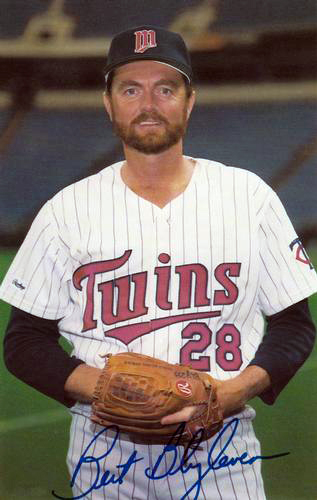
After his first year of Baseball Hall of Fame eligibility in 1998, Blyleven was widely considered to be the best eligible pitcher not yet enshrined. According to Matt Welch of Reason Magazine, "there had long been a strong case that the Dutch-born curveballista was the most deserving player on the outside of Cooperstown looking in." Still, it was not until his 14th year of eligibility, in 2011, that he was elected; he received 79.7% of the vote. He currently ranks fifth all-time in strikeouts, ninth in shutouts, and 27th all-time in wins. At the time of his election, he was the only eligible member of the 3,000 strikeout club and the only pitcher with 50 or more shutouts not in the Hall of Fame. Blyleven received only 17.6% of the vote for Hall of Fame admission in 1998 (his first year of eligibility), and his vote total dropped to 14.1% in 1999. No player who had debuted on the ballot since 1970 had a vote total that low and later won election to the Hall. However, ESPN.com columnist Jayson Stark said, "No player has ever—and again, that word is 'ever'—had his Hall of Fame candidacy helped more by the sabermetrics boom than Blyleven." Specifically, according to Welch, "the president and chief investment officer of Lederer & Associates Investment Counsel in Long Beach, California, a guy by the name of Rich Lederer, began spending some of his off-hours writing analysis on the Interwebs about Blyleven's overlooked case." By 2006, his total had increased to 53.3%. In 2007, Blyleven's total dipped to 47.7% (75% is the minimum required for admission to the Hall). In 2008, he received 336 votes, or 61.9% of the vote. In 2009, he gained only two votes, for a total of 338, 62.7%. In 2010, Blyleven had 74.2% of the votes, missing admission to the Hall of Fame by only 5 votes (0.8%). Bert Blyleven's number 28 was retired by the Minnesota Twins in 2011. Blyleven was inducted to the Hall of Fame in 2011 after receiving 79.7% of the vote on his 14th attempt. "It's been 14 years of praying and waiting," he said on a conference call. "I thank the baseball writers of America for, I'm going to say, finally getting it right." Blyleven was the first Dutch-born player inducted. His Hall of Fame plaque depicts him with a Minnesota Twins cap. Blyleven was inducted into the Minnesota Twins Hall of Fame in 2002 and was selected by fans to the "All-Metrodome Team" on July 28, 2009. On July 16, 2011, the Twins retired Blyleven's number. In 2020, sportswriter Joe Posnanski ranked Blyleven at number 71 on The Athletic's "Baseball 100" list.
Broadcasting career
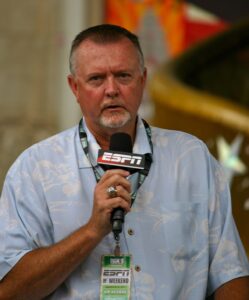
Blyleven answering questions in March 2011
In 1996, Blyleven became a television color commentator for the Twins, calling games for WCCO-TV and Midwest Sports Channel (later Fox Sports North). Blyleven's commentary was occasionally risqué for a baseball broadcast but provided interesting and friendly conversation between him and play-by-play announcer Dick Bremer.
One of his trademarks was circling fans with the telestrator on screen. Fans, both at home and at road games, carried signs to the games saying "Circle me Bert". This led to a fundraising campaign with the Parkinson's Foundation and a sponsorship with the Minnesota Lottery. When announcing partner Bremer attempted to circle fans with the telestrator, he drew geometric forms that were non-circular, and Blyleven and fans started to jostle Bremer with phrases like "Rhombus me, Dick" or "Triangle me, Dick".
On September 3, 2006, Blyleven accidentally used two profanities on air during a game against the New York Yankees because he believed the broadcast was being taped rather than aired live. FSN North suspended Blyleven five games for the incident, stating: "Bert would never do this intentionally. Having said that, there are consequences for our actions, and we feel this is an appropriate consequence.
On September 2, 2020, Blyleven broadcast his final game for the Twins. He became a special assistant for the Twins.